The Space Between: How Maria Santos Built Community in a Vanishing City
The Last Meeting at Rosario’s
The chairs are stacked against the wall now, and the community bulletin board that once buzzed with meeting notices and mutual aid requests sits empty. Rosario’s Community Center closed its doors last month after thirty-seven years, taking with it not just a building but an entire ecosystem of neighborhood organizing that Maria Santos spent two decades nurturing.
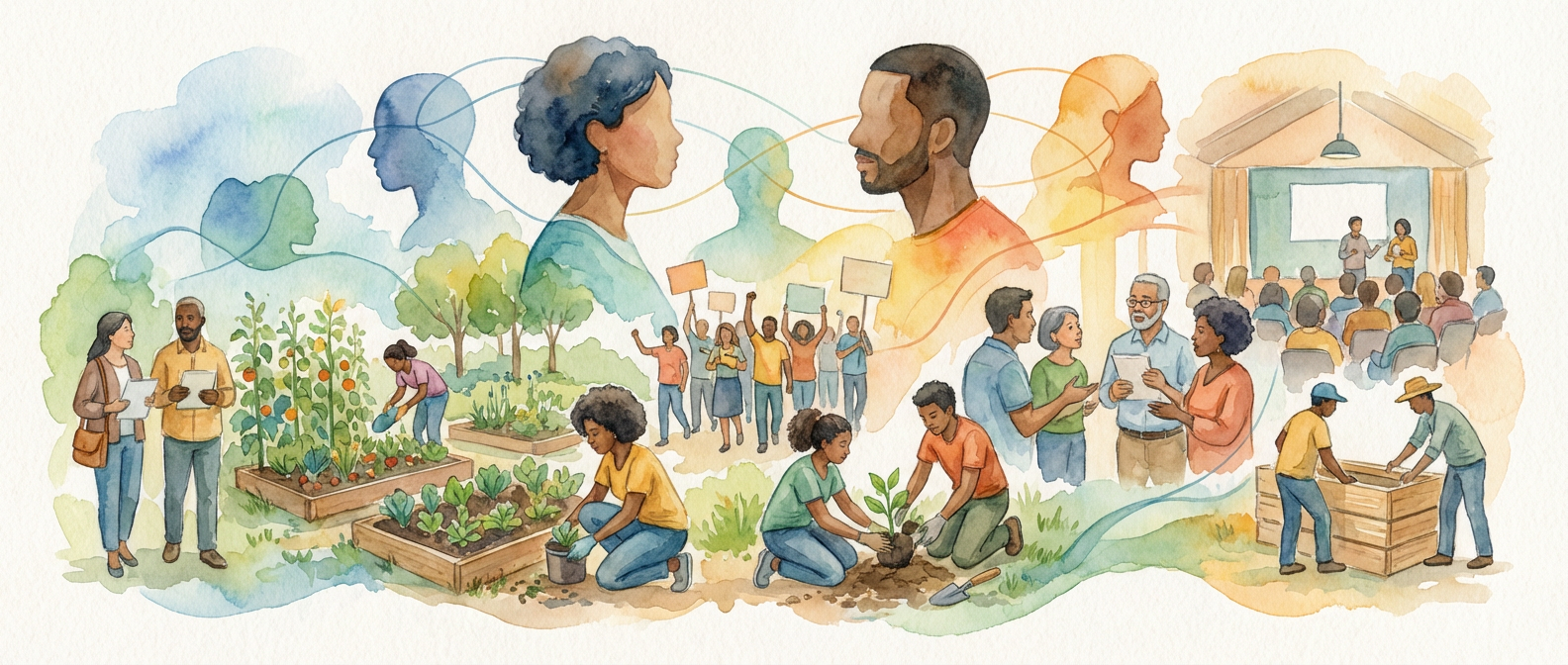
Santos, 54, stands in the empty main room where she held her first tenant rights workshop in 2003. The linoleum is scuffed from countless folding chairs, and you can still see the outline where her “Know Your Rights” banner hung. “This is where Mrs. Chen learned she didn’t have to accept that broken heater,” she says, pointing to a corner by the windows. “Where the Ramirez family found out about the rent stabilization program. Where we planned the successful fight against that predatory check-cashing place.”
The building’s demolition starts next week. Luxury condos are planned for the site.

Building Power One Kitchen Table at a Time
Santos never planned to become the neighborhood’s go-to organizer. She moved to the area in 2001, a single mother looking for affordable housing near her job at the medical center. What she found was a community under siege from displacement, neglectful landlords, and city services that seemed to forget this corner of the East Side existed.
Her organizing style was distinctly personal. She’d show up at people’s apartments with homemade tamales and stay until the problem was solved or the next step was clear. “Maria doesn’t do rallies and bullhorns,” says longtime resident and collaborator David Kim. “She does kitchen table conversations that turn into action plans.”
The numbers tell part of the story: over 400 families helped with housing issues, three slumlords forced to make repairs, one community garden established, and dozens of young people connected to job training programs. But the deeper impact was in how Santos taught neighbors to see themselves as agents of change rather than victims of circumstance.
Her breakthrough moment came in 2005 during the fight to save the corner grocery store that doubled as an unofficial community hub. When the owner faced eviction, Santos organized a campaign that mixed legal advocacy with economic pressure, ultimately helping him secure a new lease. More importantly, the campaign created a network of residents who’d learned they could actually win things.
The Slow Violence of Gentrification
Santos watched her life’s work get chipped away in real time. First came the coffee shop that charged five dollars for drinks and didn’t hire locally. Then the boutique that sold vintage band t-shirts for what people here spent on groceries. Each new business meant lost space where neighbors used to gather.
“Gentrification isn’t just about rent increases,” Santos explains. “It’s about the disappearance of informal gathering spaces. The laundromat where people shared information. The corner where teenagers hung out safely. The community room where we held meetings.”
She adapted her organizing to meet the new challenges, but the tools that worked against negligent landlords proved useless against global investment capital. Property values in the neighborhood shot up 180 percent between 2010 and 2020. Santos estimates that 60 percent of the families she worked with over the years have been displaced.
The final blow came when Rosario’s lease wasn’t renewed. The building’s new owners cited “development plans” and offered a temporary space in a strip mall fifteen minutes away by car. For a community where many residents don’t drive, it might as well have been in another city.
Legacy in the Details
Walk through the neighborhood with Santos and you see the geography of her organizing work. There’s the apartment building where she helped tenants form an association that’s still active. The empty lot where she fought for streetlights after a series of assaults. The corner where she organized the neighborhood watch that evolved into a mutual aid network.
Her influence shows up in unexpected places. Carmen Rodriguez, now a city council aide, traces her political involvement back to a housing workshop Santos led in 2008. James Murphy, who runs a successful food truck business, says Santos connected him to the small business development program that got him started.
“She never made it about herself,” says Ana Guerrero, who took over much of Santos’s tenant organizing work when Santos shifted to fighting the community center closure. “Maria would work for months on a campaign and then make sure someone else got to speak at the press conference. She built leaders, not followers.”
Now Santos is moving to the next town over, where rent is still manageable and where she’s already spotted three families facing eviction. She’s 54, experienced, and ready to start over. But something irreplaceable has been lost in the process.
What Survives
The hardest part about covering community organizing is that the most important victories are often invisible. Santos didn’t just help people solve individual problems, she created a culture where neighbors looked out for each other. That culture exists independently of any building or formal organization.
You can see it in how longtime residents still check on elderly neighbors, how parents coordinate informal childcare networks, how information about jobs and resources spreads through text message chains that started in Santos’s workshops. The knowledge she built lives on in dozens of small daily interactions.
The community garden she helped establish is still thriving, now managed by a collective of residents who learned organizing skills in her campaigns. The tenant association she helped form at the largest apartment complex continues to negotiate with management and has successfully prevented several evictions.
Santos’s phone still rings regularly with calls from former neighbors seeking advice or asking her to recommend organizers in their new communities. She’s become an informal hub connecting displaced residents to resources across the metro area.
The work continues, just more scattered now. The neighborhood she spent twenty years helping to build has been fundamentally altered, but the relationships and skills she encouraged have adapted to survive in new contexts. It’s a bittersweet legacy: proof that community organizing works, and evidence of how fragile the spaces that sustain it can be.

How Organizations Use Busyness as Status
How Unwritten Rules Determine Who Advances
The Hidden Currency of Overwork: How Organizations Turn Busyness into a Status Symbol
About Author
