The Hotel Lobby Is Dead, Long Live the Hotel Lobby: What Ace’s Fall and Its Rivals’ Rise Reveal About Travel in 2025
The Lobby Used to Mean Something
Remember when stepping into an Ace Hotel felt like walking into the right party? Not because anyone told you it was cool, but because you could feel it the moment the revolving door closed behind you. The lobby was a living thing. People actually wanted to be there. The coffee was excellent. Someone interesting was always sitting in that one chair reading something obscure. There was a real sense that something authentic was happening, that you weren’t just a guest but a temporary member of a community.
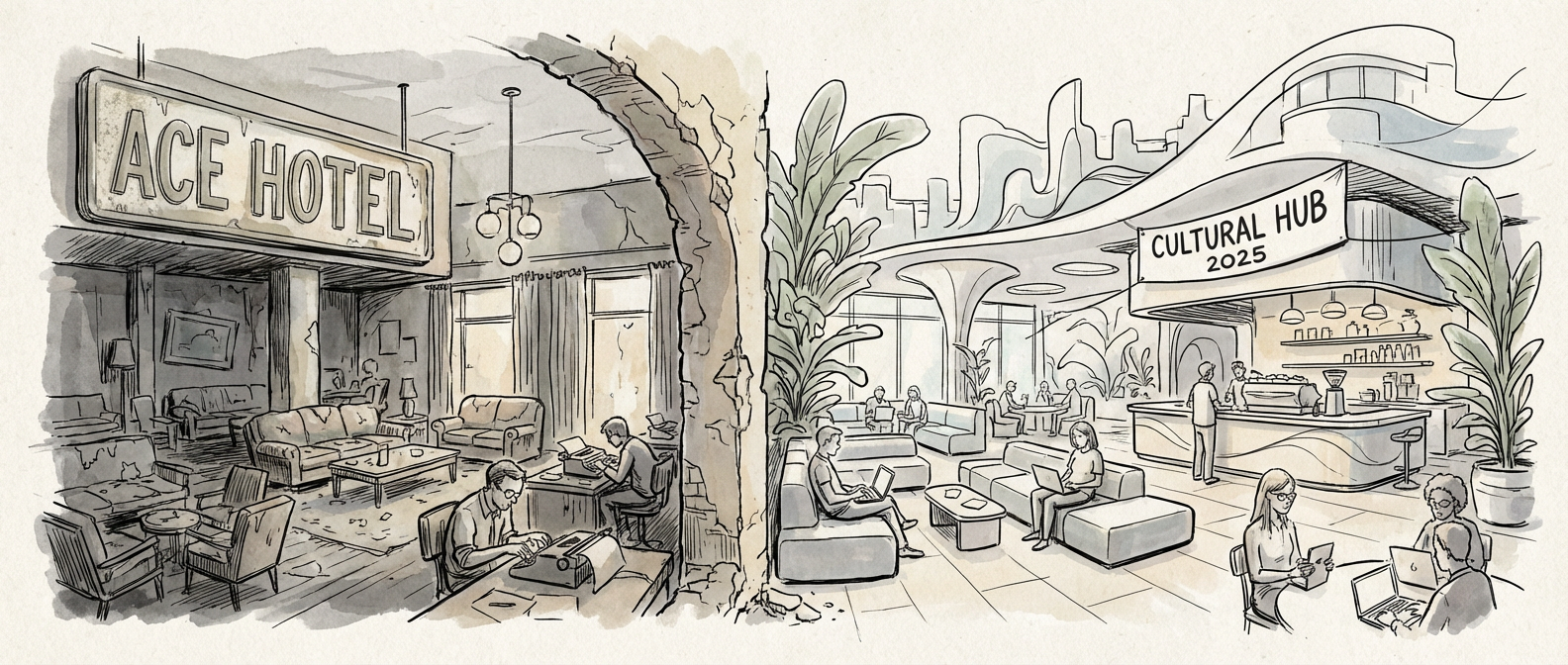
That’s not nostalgia talking. That was the actual design philosophy. Ace built its entire empire on the idea that a hotel lobby could be a cultural institution, not just a transaction space. They hired curators. They commissioned art. They treated the lobby like it mattered as much as the rooms upstairs. For fifteen years, it worked. Travelers didn’t just stay at Ace Hotels. They wrote about them. They sent photos. They told their friends about the experience like they were recommending a secret bar.
But authenticity is expensive to maintain. Somewhere between 2019 and 2023, the formula started breaking down. By the time Ace Hotel Group filed for Chapter 11 bankruptcy in March 2024, cultural critics weren’t talking about financial mismanagement or real estate decisions. They were talking about something harder to quantify: the loss of genuine curation. The lobbies started feeling curated, which is exactly when they stopped being authentic. And once that happened, there was nothing left to sell that you couldn’t get somewhere cheaper.

The Standard Hotels Figured Out What We Actually Want
While Ace was filing paperwork, The Standard Hotels was quietly running an experiment in the opposite direction. They took the lobby seriously. Genuinely serious. The kind of serious that comes from asking: what if we stopped thinking about the lobby as retail space and started thinking about it as culture?
The results speak for themselves. The Standard reported a 27% revenue increase in 2024 and 2025, according to the Skift 2025 Hospitality Intelligence Report. That growth didn’t come from raising room rates. It came from what they were doing in the lobby. Artist residencies. Weekly DJ sets. Programming that gave people a reason to be downstairs, a reason to invite friends over, a reason to stay longer and spend money on things they hadn’t planned to buy. They understood something fundamental: people will pay for access to authenticity. They will not pay for the performance of authenticity.
The Standard’s approach feels almost counterintuitive in an era of efficiency. They’re treating the lobby like a gallery, a music venue, and a community space simultaneously. And it’s working because it’s not a marketing strategy. It’s actually what they’re doing.
Graduate Hotels Is Building the Local Future
Meanwhile, a different player entirely is reshaping what it means to be a hotel in a college town. Graduate Hotels was acquired by Adventurous Journeys Capital Partners, and in 2025 they opened eleven new properties, each one built around a radical idea: what if the hotel actually belonged to the city it was in?
Every new Graduate location features locally commissioned murals. The lobby bars aren’t trying to be “Instagram-worthy.” They’re trying to be where local people actually want to drink. The staff knows local artists. They know which musicians are worth paying attention to. They’re not importing culture from New York or LA. They’re actively pulling it from the community that exists right there. It’s the opposite of the generic hotel experience, and it’s happening in places that generic hotels usually ignore.
Graduate gets it. You can’t fake belonging. You can’t overnight a sense of place. You have to actually care about the city, invest in it. And when you do, people respond with loyalty that transcends the usual hotel relationship.
The Data Says: Culture Is the Currency Now
Here’s where it gets interesting from a numbers perspective. A 2025 Cornell University study of hotel administration found something that would have sounded wild five years ago: guests who actually engaged with cultural programming in hotel lobbies spent an average of 34% more money on other services. Food, drinks, events, merchandise. Everything. They weren’t just more satisfied. They were more generous with their wallets.
That’s not because they were rich. That’s because engagement creates value. When someone feels like they’re part of something real, they invest in it emotionally, which translates to financial investment. The lobby stopped being where you check in and started being where you spend.
Even more telling: according to the Airbnb 2025 Travel Trends Report, 41% of travelers under 35 now say “local cultural atmosphere” is their top booking criterion. Price, for the first time in the survey’s history, isn’t number one anymore. Young travelers are choosing experience over economy. They’re choosing authenticity over convenience. They’re choosing places that feel like they belong to somewhere rather than nowhere.
What This Actually Means
The hotel lobby collapse and the simultaneous rise of places that take culture seriously tells us something fundamental about where we are in 2025. We’re tired of performance. We’re tired of aesthetics divorced from reality. We’re tired of design that’s trying to manipulate us into feeling something we don’t actually feel.
The hotels winning right now are the ones treating their lobbies like real places. Not museums. Not stages. Real places where real things happen. Where the art program isn’t about prestige. Where the DJ set isn’t about looking cool. Where the bar is genuinely where people from the community gather.
This matters beyond hospitality. It tells us that authenticity isn’t optional anymore. It’s the baseline expectation. The question isn’t whether to build cultural programming. The question is whether you’re going to do it honestly or whether people will figure out you’re faking it and go somewhere else.
What hotel lobby surprised you recently? Or what place did you find that felt genuinely real? I’m curious where you’re discovering these spaces now. Tell me what you’ve found.

Amenhq

The Hidden Fault Lines: How Performance Reviews Reinforce Existing Bias
The Performance of Overwork: How Busyness Became a Workplace Status Symbol
About Author
